
NICK HERRMAN VISITING THE CATALYSIS INSTITUTE FROM THE UNIVERSITY OF HAMBURG IN GERMANY
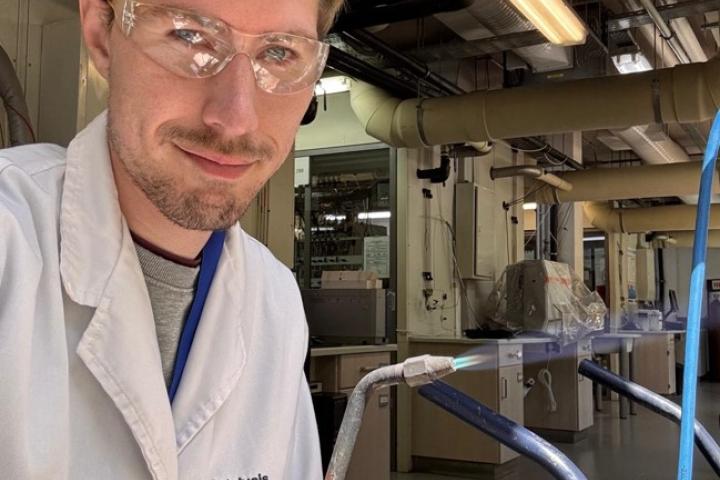
Welcome to the Catalysis Institute! Could you tell us a bit about yourself, your background and what brought you to UCT? Thank you for asking. My name is Nick Herrmann, I am 28 years old and am currently in the third year of my PhD. I studied chemistry at the University of Hamburg in Germany and was looking for a more application-orientated research topic for my PhD. Therefore, I started my PhD at the research group of Prof. Jakob Albert, where I study the methanol synthesis from CO2 and H2 with indium-based catalyst as well as the methanation of CO2 with novel Ni/MgO catalysts. My supervisor Prof. Nico Fischer, met with me at a conference and discussed collaborating on some of our indium catalyst and the in situ XRD setup at UCT. Near the end of the collaboration, I asked Nico if I could conduct research in his labs. After discussing the details and acquiring funding, I was on my way to Cape Town.

What research will you be focusing on during your visit, and how does it connect with the work being done at the Institute? Since I was working with indium-based catalyst in the hydrogenation of CO2, I was curious to find out if a C-C coupling to longer hydrocarbons is possible. Since the Catalysis Institute at UCT has a lot of experience in the field of Fischer-Tropsch synthesis, I figured it could be a good match. I proposed a synergistic effect between indium and the typical Fischer-Tropsch metals, such is iron and cobalt. I synthesized my catalyst and started testing their performance in the slurry reactor.
Collaboration is at the heart of the Institute’s mission. How do you see your expertise contributing to - or benefiting from - this research environment? Although I have worked with many different reactor setups in the past, a Fischer-Tropsch reactor is new to me. I already learnt how to handle the catalyst reduction, the handling of the hot melted wax, and the sampling techniques. I have seen quite some differences on how my peers are handling their lab work, setting their focus and solving problems. Whilst talking to my peers, I have seen another perspective on the research and that there are different ways to handle it. In those discussions, I could contribute with my work experiences from back home, and learnt a lot about how they work and to stay motivated!
What are you most looking forward to exploring - scientifically or personally - during your time in Cape Town? To me, the most important part during my research stay is not doing the actual research, but learning the different ways of how research is done by others, and how the people in Cape Town are living. In my first two weeks, I already got to know so many new people. I am looking forward to learning even more about the local culture, the university and daily life here. I want to continue to enjoy nature with some hikes all around table mountain, and go out dancing and meeting new people there as well.
Is there anything else you want to share? I am very glad to have this opportunity to be here. Although it is not a vacation and I have to work, I still manage to have a lot of interactions with Capetonians. Having an inside look, gives me the feeling of being more connected and part of the daily life in Cape Town. I am truly getting to know the people and see what concerns them and motivates them. I am very grateful for the experience!