UCT, CBE partner to reshape SA infrastructure
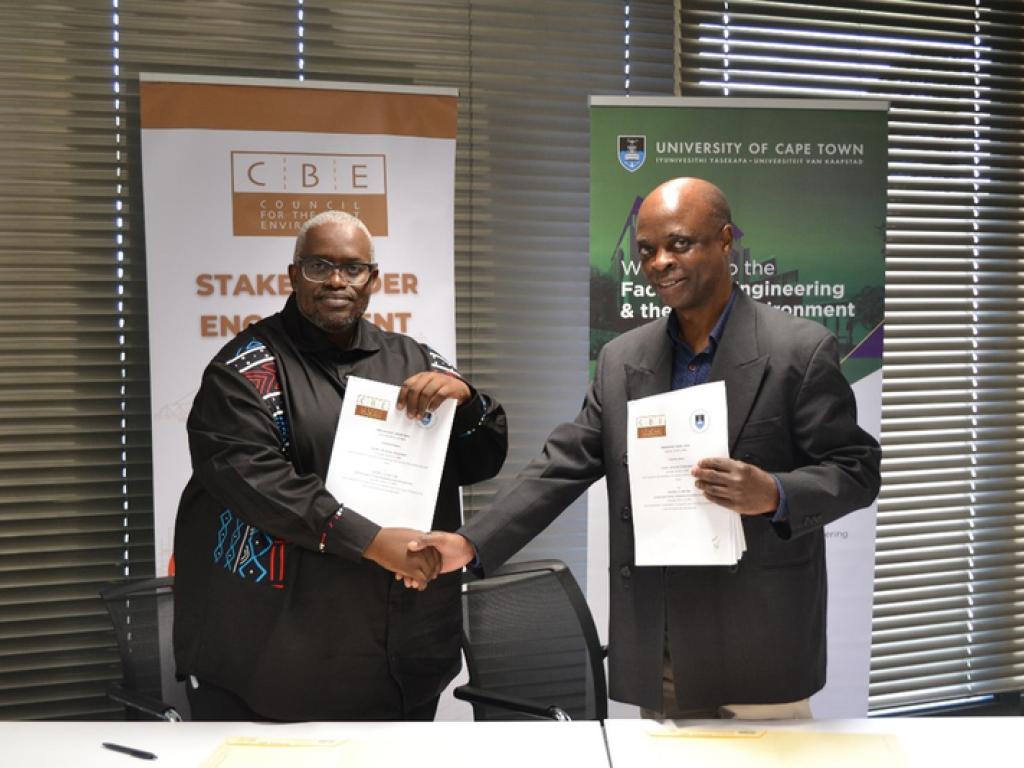
Dr Msizi Myeza (left) and Prof Aubrey Mainza celebrate the signing of the agreement between UCT and CBE.
The University of Cape Town (UCT) and the Council for the Built Environment (CBE) have signed a Memorandum of Understanding (MoU) that will reshape the way academia, government, and the built environment sector work together to address national priorities.
The agreement was concluded on 29 September 2025 by UCT’s Faculty of Engineering & the Built Environment (EBE) and the CBE.
The CBE, a Schedule 3A public entity that reports to the Department of Public Works and Infrastructure, was established through the Council for the Built Environment Act 43 of 2000. It coordinates six statutory professional councils for architecture, landscape architecture, engineering, property valuers, project and construction management, and quantity surveying. Through additional agreements, its scope extends to town and regional planning, land surveying, and environmental assessment.
The CBE’s mandate is to promote professional conduct in the built environment, drive transformation, protect the public interest, and advise government on key issues. Its new partnership with UCT and other higher education institutions sets out a framework to:
Elevate knowledge into impact: translate research into evidence-based policy and practice through engagement with professional councils.
- Strengthen the skills pipeline: expand opportunities for students and graduates through work-integrated learning, candidate programmes, and professional registration.
- Champion transformation: support historically underrepresented institutions and groups, positioning the built environment as a driver of equity.
- Lead in the Fourth Industrial Revolution: embed indigenous knowledge, digital innovation, sustainable materials, and climate resilience into professional training and practice.
Bridging academia and industry
UCT’s dean of EBE, Professor Aubrey Mainza, emphasised the faculty’s leadership role: “Our faculty is committed not only to academic excellence but to shaping solutions for the real challenges facing our country and continent. This collaboration with the CBE ensures that our students and researchers are directly contributing to national priorities and global goals.”
By combining the CBE’s regulatory influence with UCT’s academic expertise, this agreement positions South Africa’s built environment sector as a catalyst for transformation and innovation.
Filling a critical gap
As one of the original signatories to the Antarctic Treaty in 1959, South Africa has held custodianship over the Antarctic sector. However, for several decades, the country has struggled to fulfill its obligations. This project aims to fill a critical gap in long-term observations of the Fimbul Ice Shelf, a key area significantly impacted by global warming.
Antarctica’s ice shelves, which form three-quarters of its coastline, are vital for the stability of the massive ice sheets that contain about 60% of the world’s freshwater. With a complete melt of these ice reserves projected to cause a staggering 58-m rise in global sea levels, understanding the dynamics of ice shelves like Fimbul is more crucial than ever.
Recent alarming trends, including record low sea ice levels and the accelerated retreat of Antarctic ice shelves, have raised concerns about the impact of climate change on the continent. The project’s interdisciplinary team of engineers, glaciologists, geodesists, and geophysicists will deploy advanced GPS and radar equipment to monitor the ice shelf’s thickness and movement over time. This data will feed into computer models that predict future changes in the Fimbul Ice Shelf over the next 50 to 100 years under various climate scenarios.
The expedition will also assist in the logistical support of SANAE IV, facilitating reconnaissance to identify crevasse hazards, ensuring safety for future research expeditions and operations in the area.
Informing policy and conservation efforts
With the urgent threat of climate change looming over our planet, this expedition not only enhances South Africa’s role in Antarctic research but also contributes to the global understanding of climate impacts, ultimately helping to inform policy and conservation efforts in the face of an uncertain future. The collaboration with renowned international research institutes and a robust team of experts further strengthens the mission’s significance, showcasing a united effort to tackle one of the most pressing challenges of our time.
“This partnership embodies the spirit of the ministerial dialogue with deans and heads of schools of built environment faculties who committed to bridging the gap between theory and practice. Therefore, the signing of this MoU is more than an agreement; it is a commitment for joint implementation of tangible programmes to transform South Africa’s infrastructure landscape,” said CBE chief executive officer, Dr Msizi Myeza.
This partnership signals a new chapter for South Africa’s built environment. It moves beyond the act of building to reimagining infrastructure that is sustainable, inclusive, and responsive to the country’s future needs.